THE ALIGN FRAMEWORK
Growth and clinical integrity should reinforce one another, not compete.
ALIGN is a healthcare leadership framework for connecting growth strategy with the clinical governance, operational infrastructure, and accountability required to scale responsibly.
Built from the realities of complex care delivery, ALIGN provides a structured way to identify where organizational growth is creating clinical or operational risk—and where stronger systems can improve both performance and care.
A framework for responsible growth, stronger governance, and sustainable care delivery.
Why ALIGN Exists
Growth creates opportunity. It also creates risk.
Healthcare organizations are often built to pursue growth before the clinical and operational infrastructure required to sustain it is fully developed.
As volume increases, small gaps in leadership oversight, documentation, workforce capacity, eligibility governance, and performance monitoring can become enterprise-level vulnerabilities.
ALIGN was developed around a simple principle: growth strategy and clinical governance cannot operate independently.
Sustainable growth requires organizations to understand not only where they want to go, but whether their people, processes, controls, and clinical systems are prepared to get them there.
The goal isn't to slow growth. It's to build an organization capable of sustaining it.
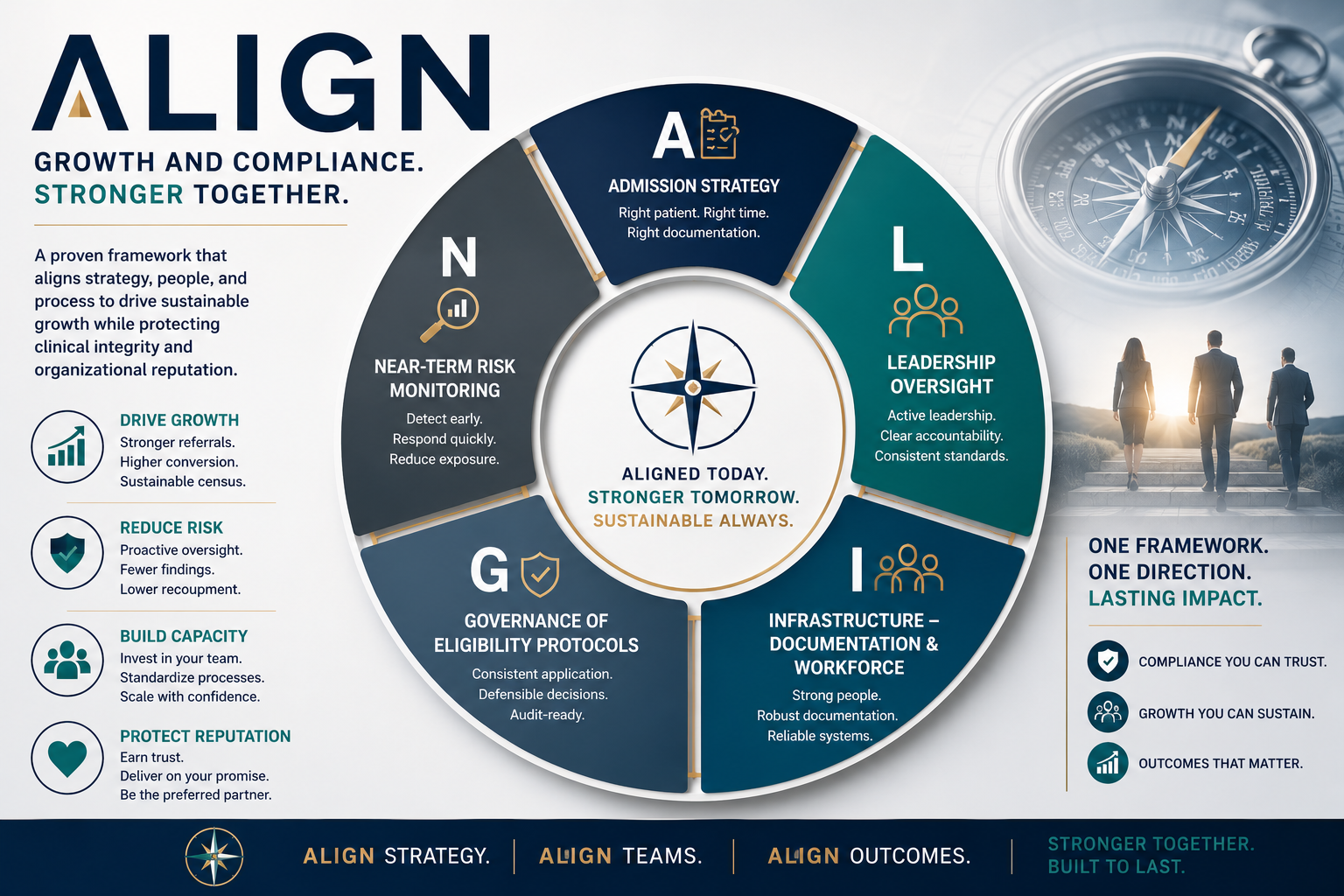
ALIGN examines five interconnected dimensions that determine whether growth can be translated into sustainable clinical and operational performance.
Five Dimensions. One Operating System.
A — Admission Strategy
Right patient. Right time. Right documentation.
Growth begins with who enters the care model and why. Admission strategy aligns referral development, clinical appropriateness, documentation, and organizational capacity so that growth starts on a clinically and operationally sound foundation.
L — Leadership Oversight
Active leadership. Clear accountability. Consistent standards.
Sustainable performance requires leaders who can see risk early, establish clear ownership, and translate organizational priorities into consistent execution across markets, teams, and disciplines.
G — Governance of Eligibility
Consistent application. Defensible decisions. Audit-ready.
Clinical decision-making requires structured governance that supports consistency, appropriate escalation, interdisciplinary accountability, and defensible decisions across complex patient populations.
I — Infrastructure
Strong people. Reliable systems. Defensible documentation.
Growth places pressure on workforce, workflows, technology, documentation, education, and operational processes. Infrastructure must mature alongside the organization rather than catch up after problems emerge.
N — Near-Term Risk Monitoring
Detect early. Respond quickly. Reduce exposure.
Organizations need leading indicators—not just retrospective metrics. Near-term monitoring identifies emerging clinical, operational, regulatory, and performance risks while there is still time to intervene.
FROM FRAMEWORK TO OPERATING DISCIPLINE
Alignment happens when the five dimensions operate as one system.
No single dimension of ALIGN operates independently. Admission decisions affect workforce capacity. Infrastructure influences documentation quality. Leadership oversight shapes accountability. Governance creates consistency. Near-term monitoring tells leaders where intervention is needed before risk becomes systemic.
When these elements are disconnected, organizations often respond reactively, adding controls after problems emerge, correcting documentation after performance declines, or building infrastructure after growth has already outpaced capacity.
ALIGN shifts the focus upstream by creating an operating discipline in which growth, clinical performance, and risk are evaluated together.
Strategy sets the direction. Governance creates the conditions to execute it.
WHERE ALIGN APPLIES
Built in complex care. Applicable wherever clinical performance and growth intersect.
ALIGN was developed from leadership experience in highly regulated, clinically complex care environments, where growth decisions have direct implications for quality, compliance, workforce capacity, patient outcomes, and financial performance.
The principles extend to healthcare organizations navigating similar challenges across the care continuum.
Value-Based & Population Health
Aligning care models, clinical performance, resource utilization, and accountability around outcomes.
Clinical Operations & Transformation
Building scalable workflows, leadership systems, performance measures, and clinical infrastructure around evolving models of care.
Complex Care & Advanced Illness
Creating the governance and operational infrastructure required to manage high-risk populations consistently across settings.
Technology & Responsible Innovation
Ensuring technology—including AI-enabled tools—strengthens clinical decision-making, documentation, accountability, and care delivery rather than simply adding another layer of complexity.